
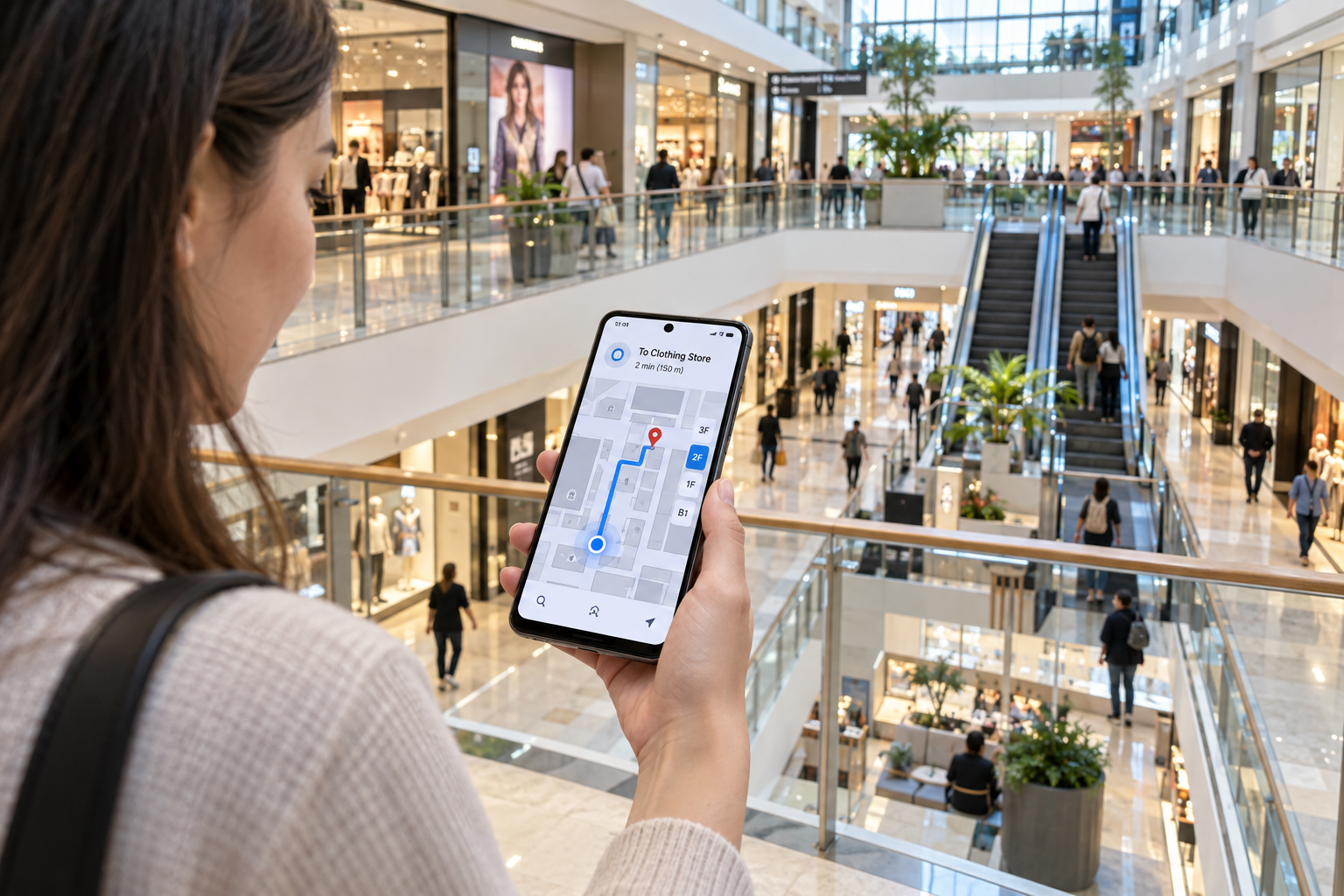
Can indoor mapping finally make getting lost in a mall a thing of the past ?
Finding a shop should be straightforward, yet a quick errand can become a circuit of escalators, identical corridors and poorly placed directories. Shopping centres are adding digital maps that promise to make these detours unnecessary. The technology can help visitors locate a store, choose the correct floor and find an accessible route. Whether it can eliminate the experience of getting lost depends on something less glamorous than a screen: reliable information about the building.
A store directory cannot guide every turn
Traditional mall directories answer one question: where is the shop? They rarely explain the journey from a particular entrance, especially when a building has several wings, split levels and car parks connected by different lifts. A visitor may see a shop marked on level two but still have no idea which escalator leads to that section. Even a short distance on a flat plan can require a lengthy walk around an atrium or through a connecting passage. Effective navigation has to represent the paths people can actually take, not simply the positions of shops. A searchable digital map gives those paths meaning. Visitors can select a destination and follow directions that distinguish a staircase from a lift, identify the next turn and account for changes of floor.
An approach based on indoor mapping for malls can also connect entrances, toilets, information desks and parking areas to the same navigable layout. That matters for people arriving with a specific purpose, such as collecting an order before an appointment, but it can also make less visible parts of the centre easier to discover. A map should tell someone where to go before they begin wandering, rather than merely confirm where they ended up. The catch is that a digital floor plan is not necessarily a live navigation system. A static interactive map may show a route after the visitor chooses a starting point; following their movement automatically requires a separate way to establish position. Confusing these functions leads to disappointment, particularly when users expect the familiar moving dot of outdoor navigation.
The hardest directions cross several floors
GPS usually struggles to locate people reliably inside substantial buildings, where ceilings and structural materials interfere with satellite signals. An academic review of indoor positioning systems describes alternatives including Wi-Fi, Bluetooth signals, phone sensors and computer vision. These technologies have different installation costs and accuracy limits. A shopping centre may already have Wi-Fi infrastructure, but radio signals can reflect off walls or travel across open atriums, making it difficult to distinguish one floor from another. An incorrect floor estimate can send a visitor towards an escalator they have already passed. Navigation therefore depends on combining a trustworthy building model with sensible route calculations and, where offered, positioning that works under real conditions.
The shortest geometric route is not always the easiest journey, particularly when it involves changing floors twice, passing through a crowded food court or using a staircase unsuitable for the shopper. Useful directions identify landmarks that visitors can recognise and allow them to restart from a known point when tracking becomes uncertain. Clear instructions such as taking the lift beside a named entrance can be more dependable than a stream of precise-looking arrows. Nor can the system be left untouched after installation. A new tenant, closed corridor or broken lift can turn yesterday’s correct route into today’s dead end. Shopping centres need a process for updating the map and reporting obstacles promptly. During a trial, managers should walk routes from different entrances and parking levels, with more than one phone model and with users who have never visited before. That is a more meaningful test than a flawless demonstration along a familiar corridor.
Accessibility is where navigation proves itself
Getting lost carries different consequences depending on the visitor. A parent pushing a buggy may be able to see a staircase but cannot use it comfortably; a wheelchair user needs dependable information about lift access, and a blind visitor may require spoken directions rather than coloured arrows. An accessible system must allow people to request step-free routes, search for facilities and understand instructions without relying solely on a visual display. The W3C’s mobile accessibility guidance covers mobile interfaces used by people with disabilities, including challenges involving touchscreens, smaller displays and alternative ways to interact. Accessibility also means avoiding instructions that demand constant attention to a phone screen while walking through busy public spaces.
Evidence suggests better guidance can make a tangible difference. In a Mall of America navigation study, 12 blind participants received spoken route instructions under different conditions. With updated, real-time guidance, they completed journeys faster, made fewer errors and sought less assistance than when equivalent directions were given only before departure. That does not prove every mall app will work equally well, but it demonstrates why information delivered at the right moment matters more than simply displaying a detailed plan. For operators, the practical calculation begins with maintenance and accessibility, not elaborate graphics. They must budget for accurate floor data, software upkeep, any positioning equipment and staff responsible for recording tenant moves or temporary closures. Kiosks and readable physical signs still matter for visitors without compatible phones, enough battery or mobile internet. Privacy deserves attention, too: finding a lift should not require unnecessary collection of someone’s movement history.
The end of aimless wandering?
Indoor maps can remove much of the guesswork, but only when directions match the building as it exists today and work for different visitors. The realistic goal is not a shopping centre where nobody ever takes a wrong turn. It is one where recovering from that turn becomes effortless, quick and intuitive.